Articles
AI at Work: How can we ensure AI helps people, instead of replacing them?
17 November 2026
Topic
Artificial Intelligence
As artificial intelligence (AI) becomes more commonly used in workplaces, authors of the white paper When Does AI Augment Work? A Workflow-Level Framework for Human-Agent Collaboration ask an important question: how can AI improve human workflows without threatening human autonomy?

From drafting emails to analysing data, AI is changing the way we work. But when it comes to the future of work, perhaps the most important question is not to ask what AI can do, but how it should be used.
A recent white paper (opens in new tab) by experts from academia, industry and the Manpower Research and Statistics Department suggests that the best outcomes come not from having AI take over tasks wholesale, but from redesigning work so that humans and AI complement each other's strengths.
AI success is not just about productivity
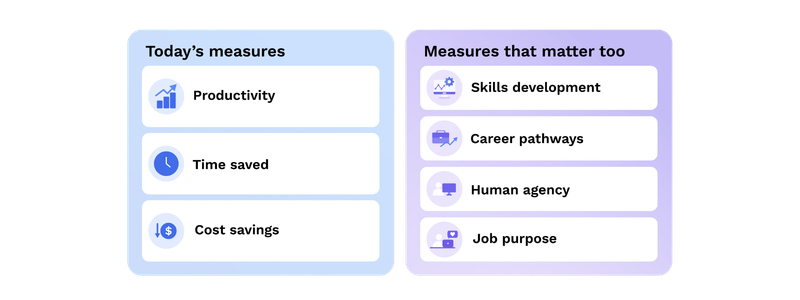
When it comes to adopting AI, measures typically used to evaluate success include productivity gains, time savings and cost reductions
These indicators of success are important, but do not tell the whole story. For instance, while an AI tool may produce a report in a few minutes, employees may still need to spend time checking facts, correcting errors and approving the final output.
To understand the true impact of AI, we need to look beyond individual tasks and examine the entire workflow, including how people and AI work together.
In that case, what does good AI use look like?
The paper proposes several conditions to identify the positive impact that AI enacts in the workplace more definitively. These can be summarised into three simple questions.

Does AI create real value?
AI should improve overall workflows and work quality. This means looking not only at time saved, but also at the effort needed to review, correct and manage AI-generated outputs. Three properties for consideration are:
Verifiability: Can a qualified person inspect the output and identify failure?
Reversibility: Can an error or action be corrected before serious harm occurs?
Stakes: What follows if the decision is wrong, delayed, or difficult to contest?
These properties of the AI-augmented task should be assessed at design, deployment, and periodic operational review.

Do people remain in control?
Over time, it may be easy to delegate high volume, procedurally defined and verifiable tasks to AI without a second thought. However, these are often the types of tasks that enable junior workers to develop tacit judgement needed to evaluate outputs, catch failures and push back on algorithmic recommendations. Hence, when incorporating AI into our work, how do we ensure that we do not lose the human capabilities required for meaningful oversight?

Are people learning continuously?
As such, people need to build expertise and progress in their careers rather than becoming overly dependent on technology. Meaningful human control must be actively maintained through task allocation which preserves the learning opportunities that AI would otherwise absorb. Preserving learning and career pathways is therefore a pre-requisite for ensuring humans occupy a meaningful role in work processes over time.
Why does this matter for Singapore?
AI adoption is growing in Singapore. According to MRSD’s report on the adoption of artificial intelligence among firms, 28.5% of firms reported adopting AI, and among those firms, 70.7% reported improvements in worker productivity. Firms were also more likely to redesign roles than reduce headcount, with employment in Singapore remaining resilient.
While these findings are encouraging, the white paper argues that productivity is only part of the picture. It is equally important to understand how AI affects the following measures over time:
Learning and skills development
Career pathways and progression
Human agency and job purpose
Monitoring these longer-term outcomes will help us better understand how AI is shaping the future of work.
The Future of Work Is Human + AI
AI has the potential to make work more productive and efficient. But technology alone is not enough. The real test is whether AI helps people remain skilled, engaged and in control while creating value for organisations and society.
As AI continues to evolve, the most successful workplaces may be those that combine the strengths of people and AI, allowing each to do what they do best.
This article is based on the white paper When Does AI Augment Work? A Workflow-Level Framework for Human-Agent Collaboration, co-authored by MRSD officers Corlyss Chua, Jeryl Ong and Soon Da Ren at the CIVIC-AI Workshop. This workshop was jointly organised by the National University of Singapore and Stanford University earlier this year.
Read the full paper: https://doi.org/10.48550/arXiv.2609.12482 (opens in new tab)