
Articles
Outlook for the Tech Sector in Singapore
28 August 2023
Topic
Job Vacancy
Competition for tech talent is driving up salaries in the sector in Singapore. Outside of the tech sector, businesses in a range of other industries also have growing digitalisation needs and with that, an urgency to attract talent who can help them get onboard with these evolving trends.

Growing prospects for the tech industry
Competition for tech talent is driving up salaries in the sector in Singapore. Outside of the tech sector, businesses in a range of other industries also have growing digitalisation needs and with that, an urgency to attract talent who can help them get onboard with these evolving trends.
Consequently, last year saw a big leap in the median gross monthly income for full-time employed residents¹ in the Information & Communications sector from $6,092 in 2021 to $7,000 in 2022.
¹ Pertains to median gross monthly income from work, including employer CPF, of full-time employed residents
Recent trend of layoffs
Although retrenchment levels have remained low in general, there was a steady increase in the number of retrenchments from the second half of 2022 through to 1Q 2023.
The Information & Communications sector was one of the three main sectors driving the increase in retrenchments in 1Q 2023, with most companies citing reorganisation and restructuring within the sector as the primary reason for the layoffs.
However, it is important to note that this does not indicate a drop in demand for talent in the tech industry. In fact, I&C remains the top industry which workers retrenched from this sector were able to find jobs in, 6 months post retrenchment.

High demand for specialised skills remains
One reason tech talent remains in high demand is because these specialised skills are needed in a wide range of sectors, including Financial Services and Wholesale Trade. As the shift towards digitalised processes continues to grow after the pandemic (such as having self-ordering kiosks in F&B establishments), the demand for talent in tech is not slowing down.
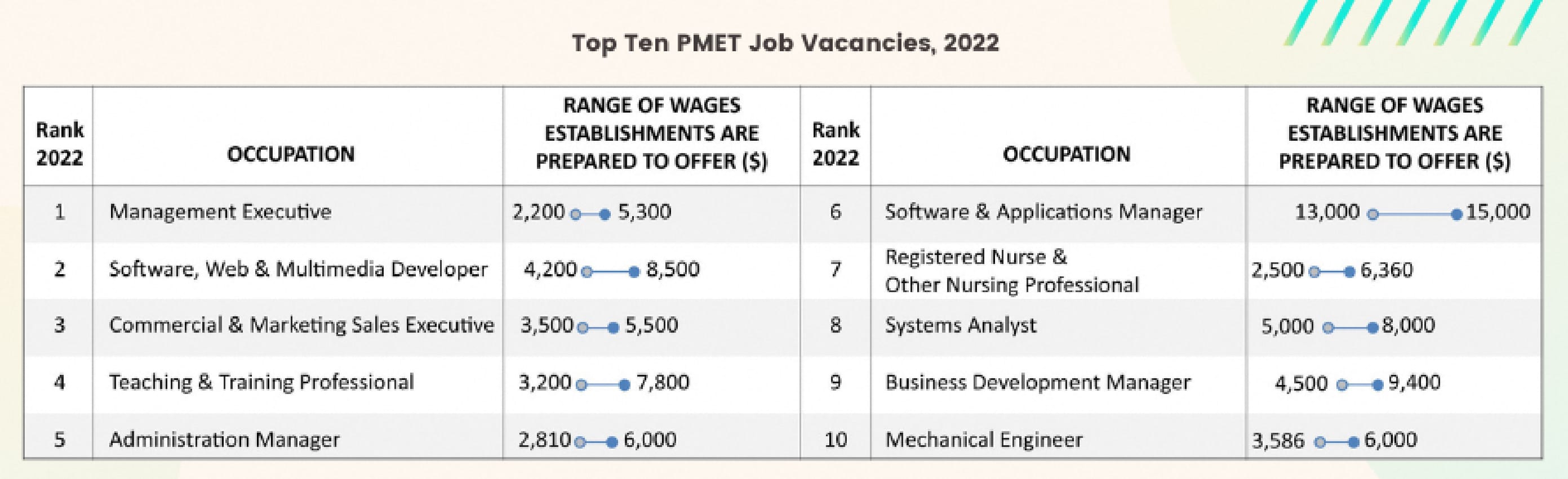
As highlighted in our recently released Job Vacancies Report 2022, 3 out of the top 10 PMET job vacancies were in the tech sector. This includes Software, Web & Multimedia Developer at #2, Software & Applications Manager at #6 and Systems Analyst at #8.

Hence, despite recent layoffs, employers would be well-advised to continue offering favourable wage conditions when it comes to attracting tech talents. Otherwise, it can be difficult to retain the loyalty of these talents when the tide turns as they can easily be enticed by better offers elsewhere.
IMDA is paving the way for digitalisation Singapore
The Infocomm Media Development Authority (IMDA) is dedicated to training both job seekers and businesses in a variety of specialised tech skills through their programmes. The nationwide movement known as SG:Digital was started in 2020 with the intention of transforming businesses and empowering individuals with a view towards improving Singapore's digital landscape.
Additionally, the Tech Immersion and Placement Programme (TIPP) allows professionals who wish to take up ICT roles to undergo training that will make them industry ready. After going through this short yet intensive programme, these professionals will take up placements in tech roles such as software developers, data analysts and mobile app developers.
The future of employment in Singapore lies in the tech sector
According to the Skills Demand for the Future Economy (SDFE) Report 2022, the top three transferrable skills across all jobs and sectors in Singapore are related to:
E-commerce
Artificial Intelligence (AI)
Digital Marketing
Data and Analytics
An increasing number of businesses are starting to provide an omnichannel experience for customers. This means a larger input of data to work with and as a result, a higher demand for talent who possess these transferrable skills.
Source: https://jobsandskills.skillsfuture.gov.sg/resources/SDFE-2022.pdf (opens in new tab)
Omnichannel retailing has resulted in a higher demand for specialised skills
Many brick-and-mortar stores today also have an e-commerce presence. Omnichannel retailing is all about providing a seamless customer experience that bridges the gap between these platforms, such as offering in-store pickups for online orders. Today's customers want it all, from the fuss-free aspect of online shopping to the interactive approach of shopping in a store.
However, the challenge of offering an omnichannel customer experience is having a larger input of data to work with. This directly translates into a higher demand for talent possessing these related transferrable skills.
Find out more about job vacancies and top jobs in the tech industry here ↗.
Subscribe to our newsletter (opens in new tab)