
Articles
Takeaways from the Job Vacancies 2023 Report
1 October 2024
Topic
Job Vacancy
In this article, let us take a look at some of the key highlights from our Job Vacancies 2023 Report.
Why are job vacancy statistics important?
Job vacancy statistics are important in helping us measure unmet demand for manpower. Information glimpsed from these statistics can enable policymakers, employers, as well as individuals, to better understand the nature of job vacancies, such as which positions are in high demand.
These insights can also help us identify the most sought-after skills in the market and make more informed career decisions.

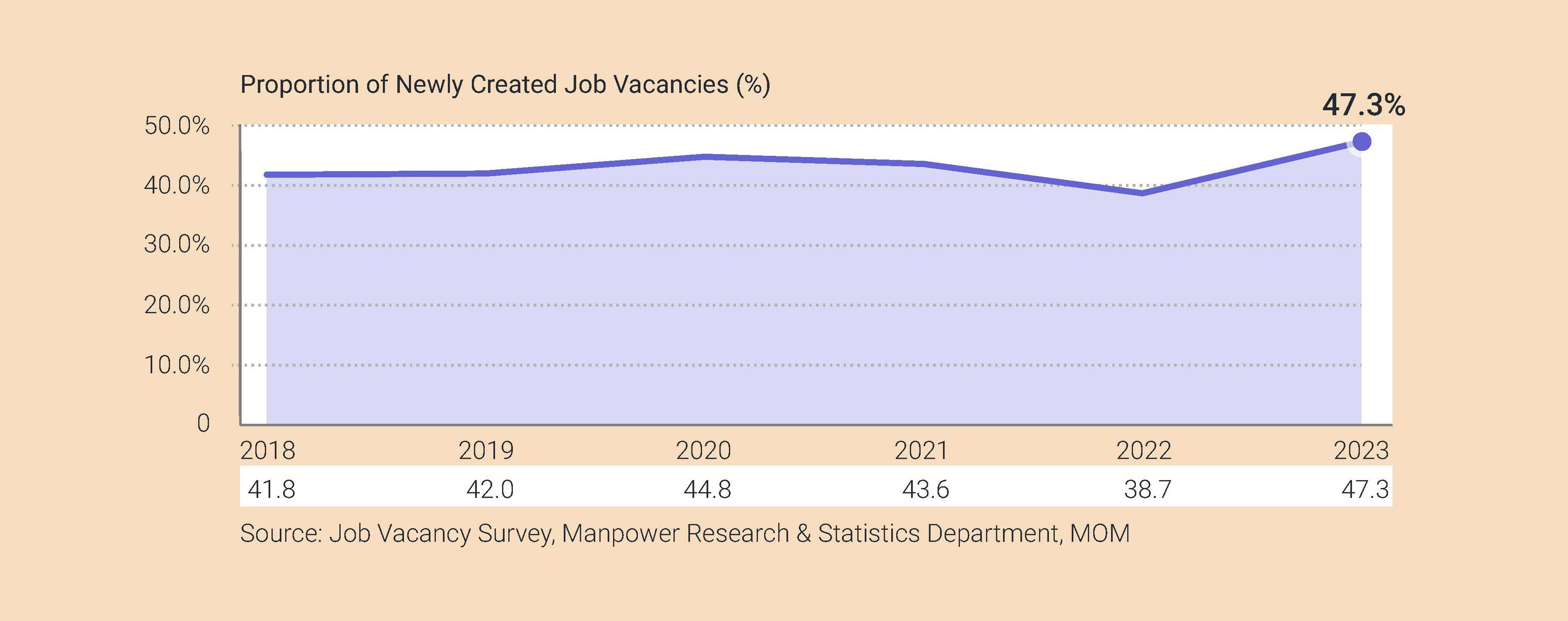
#1: Proportion of newly created positions rose to the highest since the series started in 2018
In 2023, newly created positions made up nearly half (47.3%) of the total job vacancies. The majority of these newly created positions arose due to business expansion into existing and new functions.
Similar to 2022, the industry with the highest proportion of newly created vacancies in 2023 was Information & Communications, where newly created positions made up 72.8% of its vacancies.
Singapore as the Digital Capital of Asia
This phenomenon is not surprising, given that Information & Communications (5.7% growth year-on-year) was one of the top three positive contributors to GDP growth in 2023. In fact, the sector has been one of the top positive contributors to GDP growth since the economy rebounded in 2021.
On the international stage, Singapore is known as the most digitally competitive economy in Asia. In line with this, Singapore was ranked 3rd in the 2023 IMD World Digital Competitiveness Ranking, moving up a spot from the previous year. This ranking is based on the capacity of each participating economy to utilise digital technologies as a tool to drive economic transformation.
According to the 2023 Singapore Digital Economy Report by the Infocomm Media Development Authority (IMDA), the expansion of the digital economy is driven by the increasing adoption of these technologies by enterprises, which in turn has contributed to the growing demand for manpower in the sector.
Sources:
https://www.imd.org/centers/wcc/world-competitiveness-center/rankings/world-digital-competitiveness-ranking/ (opens in new tab)
https://www.cnbc.com/2023/10/10/singapores-digital-economy-nearly-doubled-in-5-years.html (opens in new tab)

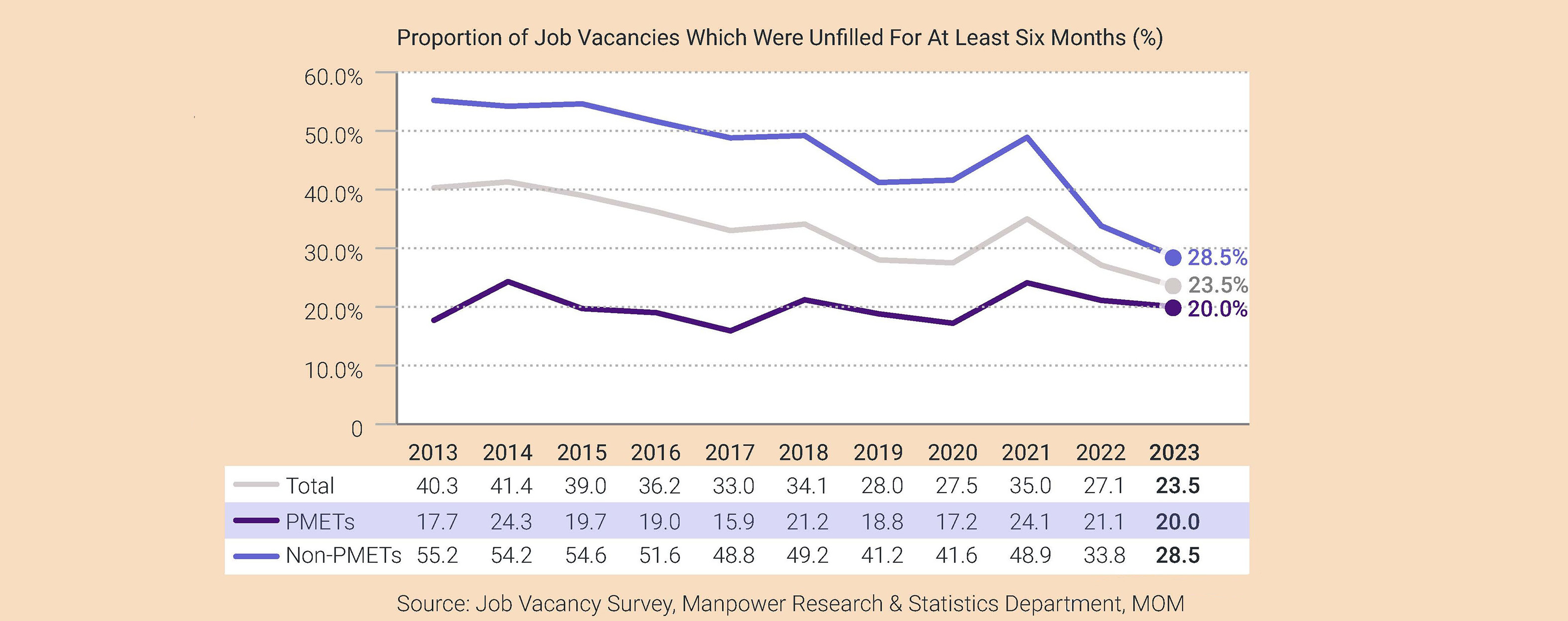
#2: Decline in proportion of job vacancies left unfilled for 6 months or more
The proportion of job vacancies left unfilled for 6 months or more went down to less than a quarter (23.5%) in 2023 from 27.1% in 2022. This decline was mainly driven by non-PMET vacancies, reflecting the success of the efforts that have been put into making these jobs more appealing over the past decade, from technological advances to job redesign and upskilling opportunities alongside progressive wage increases.
A closer look at hard-to-fill non-PMET positions
Amongst the vacancies that went unfilled for at least 6 months, the top five non-PMET roles that employers had trouble filling were: Waiter, Cleaner, Receptionist/Customer Service & Information Clerk, Healthcare Assistant, and Bus Driver.
Top reasons why jobseekers were less likely to take on these roles include: physically strenuous conditions, unattractive pay, unfavourable work schedule (preferring not to work on weekends/PHs or do shift work), and unconducive working environment.

Filling non-PMET positions: a worldwide challenge
The difficulty with filling non-PMET vacancies is not a challenge uniquely faced by Singapore. Many developed countries are finding it increasingly harder to attract candidates for non-PMET roles such as waiters, cleaners, drivers and manual labourers. The same reasons apply: potential applicants find the working conditions and salary unattractive.
Generally, within the European Union, jobs such as lorry drivers, health care assistants, and cleaners were known to be among the hard-to-fill roles. In Q2 of 2022, there were 145,053 job vacancies in Spain, with the majority of them being in Manufacturing and Construction. Similarly, in Croatia, the tourism industry has been affected by a lack of waiters, cleaners, and maids, leading to the phenomenon of a 'missing workforce'.
Sources:
https://www.surinenglish.com/spain/job-vacancies-20221125104357-nt.html (opens in new tab)

#3: Employers willing to pay more to fill PMET and non-PMET positions in demand
To fill the manpower gap for non-PMET roles, employers were willing to increase the minimum salary paid to attract waiters, cleaners, shop sales assistants, receptionists, and security guards, amongst some others. As unattractive pay is cited as one of the top reasons candidates were reluctant to take up these jobs, an increase in the minimum salary is a positive step towards filling them.
In line with this trend, employers were similarly prepared to increase the minimum salary for PMET positions in demand. In 2023, employers were willing to offer at least $5,000 to fill the top PMET job in demand: software, web & multimedia developer. This is a sharp increase from the $4,200 in 2022. Moreover, the Information & Communications sector was not the only one in which this trend was observed. The demand for candidates to fill roles such as budgeting & financial accounting manager and registered nurse & other nursing professionals meant that employers were also willing to pay a higher minimum salary for these roles.

The nature of job vacancies in Singapore is always changing as the economy evolves. Employers and policymakers can leverage on our job vacancy statistics to make jobs more appealing to jobseekers, while individuals can use this information to aid them in making important career decisions.
Find out more in the Job Vacancies 2023 report.