
Occupational Employment Dataset (OED) FAQs
Get answers to common questions about OED, including data updates, consent, access and usage.
Last updated on 11 November 2026
For specific FAQs on how the OED supports PWM assessment, visit PWM FAQs.
What is the OED?
What is the Occupational Employment Dataset (OED)?
The Occupational Employment Dataset (OED) is an online registry that collects the occupational and employment data of current workers in Singapore. All registered businesses are required to provide the latest occupational and employment details of all employees (Citizens, Permanent Residents, and Foreigners) under their payroll to the Ministry of Manpower (MOM).
For more information on all the data collected, please refer to the OED Glossary ↗ (opens in new tab).
Why do I need to provide the information collected under the OED?
By regularly compiling comprehensive occupational and employment data through the OED, it will provide valuable insights that aid in the review of manpower policies. These policies directly affect all businesses and workers in Singapore.
In addition, with complete and regularly updated OED data on organisations, MOM endeavours to use these data to complete quantitative questions in other manpower surveys such as the quarterly Labour Market Survey (LMS). This can help reduce the survey load on organisations.
OED data will also be used to assess whether organisations have met the Progressive Wage (PW) and Local Qualifying Salary (LQS) requirements. Firms that do not comply with the requirements will not be able to renew existing work passes or apply for new work passes.
How is the OED used for PWM assessment?
Developed by tripartite committees consisting of unions, employers and the government, the Progressive Wage Model (PWM) helps to uplift lower-wage workers' wages. The PWM benefits workers by mapping out a clear career pathway for their wages to rise along with training and improvements in productivity and standards.
Information from the OED will be used to compute the LQS/PWM requirements that your employees are required to meet. We will also match the OED data with the declared wage data that you submitted to CPFB to determine if your organisation has met the PWM requirements.
Please make sure you have given consent for the results of the assessment to be shared with the relevant government agencies.
Find out more about the PWM here (opens in new tab).
How to update the OED
How are the data items classified in the OED?
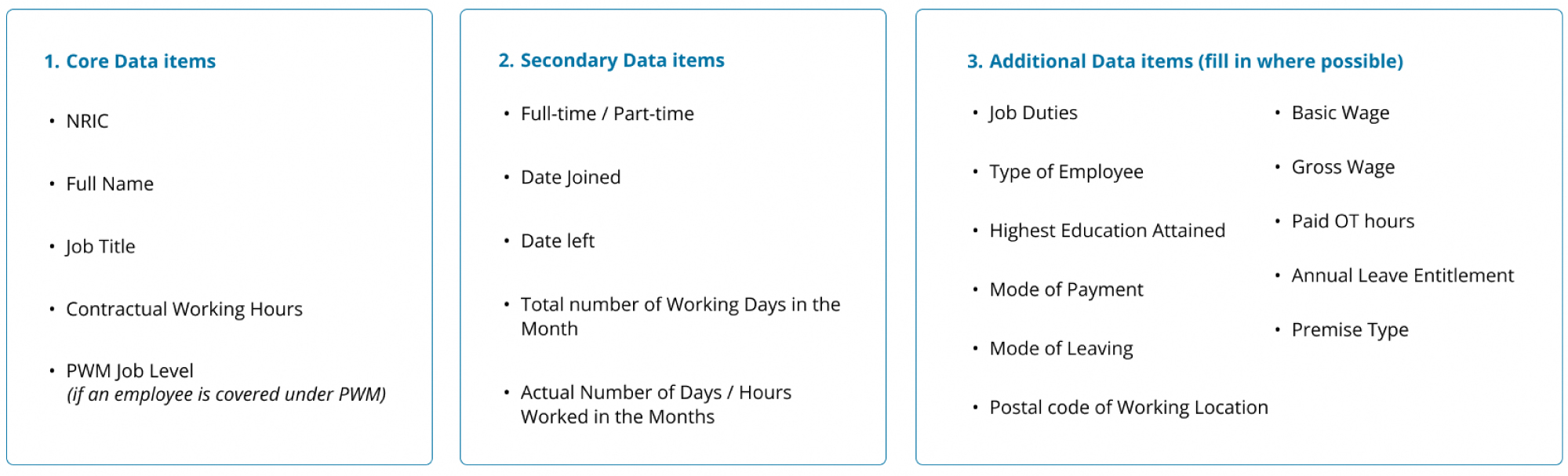
Always fill out the Core and Secondary data items first. Provide the additional data items in the event where they are available.
How do I update the OED?
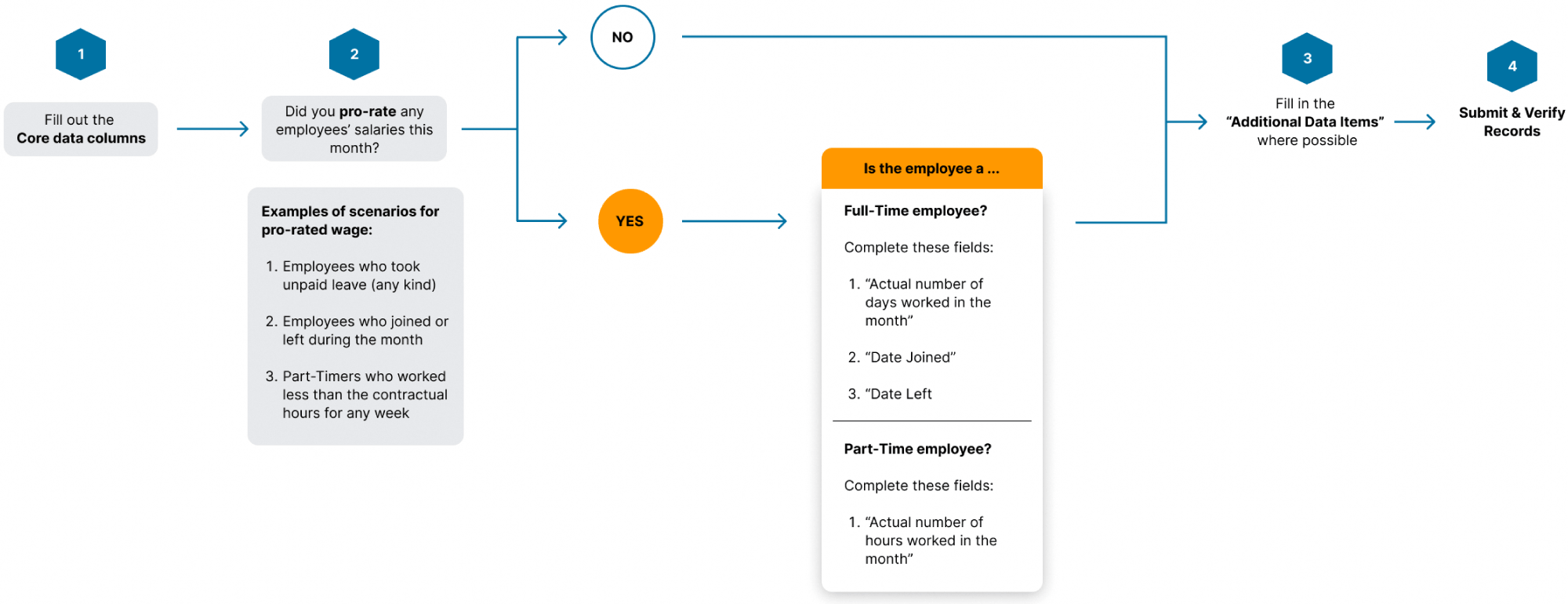
Step 1 – Complete Core data columns
If there no applicable PW workers, choose the ‘Not Applicable’ option from the dropdown list under the PWM Job Level Column.
Step 2 – Complete Secondary data columns
For employees who did not receive pro-rated salaries for the month, please proceed to Step 3.
For employees who have received pro-rated salaries for the month, you will need to complete the following based on their Full-Time or Part-Time employment contract status:
Secondary data columns for employees who received pro-rated salaries
Full-Time employees | Part-Time employees |
a. Actual number of days worked in the month b. Date joined c. Date left | a. Actual number of hours worked in the month |
Step 3 – Fill in the ‘Additional Data Items’ where possible.
Step 4 – Submit and verify your records.

Where can I update my OED information?
Update your organisation's OED information by logging in to our online portal ↗ (opens in new tab).
When do I need to submit the OED?
Your organisation is required to update the OED as and when there are changes to the occupational and employment details of your employees. If there are no changes in the new month, our system will rely on the OED records that were previously submitted.
I have questions regarding the OED. Who can I contact?
You may call our hotline at 6320 7722 from Monday to Friday (excluding public holidays), 8:30am to 5:30pm, or send us an email enquiry at mom_oed@mom.gov.sg. Please indicate the UEN of your organisation in the email subject line.
Alternatively, you may leave an enquiry at our help desk (opens in new tab) and our dedicated officers will assist you with your OED enquiries.
One-Stop Payroll (OSP)
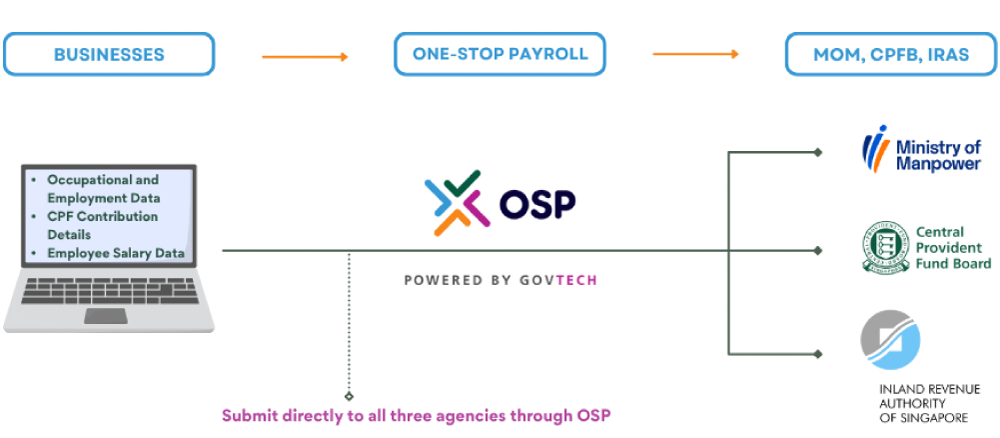
Submit payroll data to MOM, IRAS and CPFB in one go through One-Stop Payroll - this joint initiative cuts admin work by letting businesses file via a single platform.
What is the One-Stop Payroll (OSP)?
The One-Stop Payroll is a collaboration between MOM, IRAS, CPFB, and GovTech that streamlines and simplifies payroll and employment-related regulatory requirements for businesses and employers.
What are the key benefits of the OSP?
Key benefits:
Submit payroll information to multiple agencies through a single platform
Integrate directly with your existing payroll software
Reduce administrative overheads and compliance costs
Submit Occupational and Employment Data effortlessly
By onboarding OSP (opens in new tab), businesses and software developers can unlock substantial savings through a seamless process for submitting payroll and employment-related data.
Automated Data Transfer (ADT)
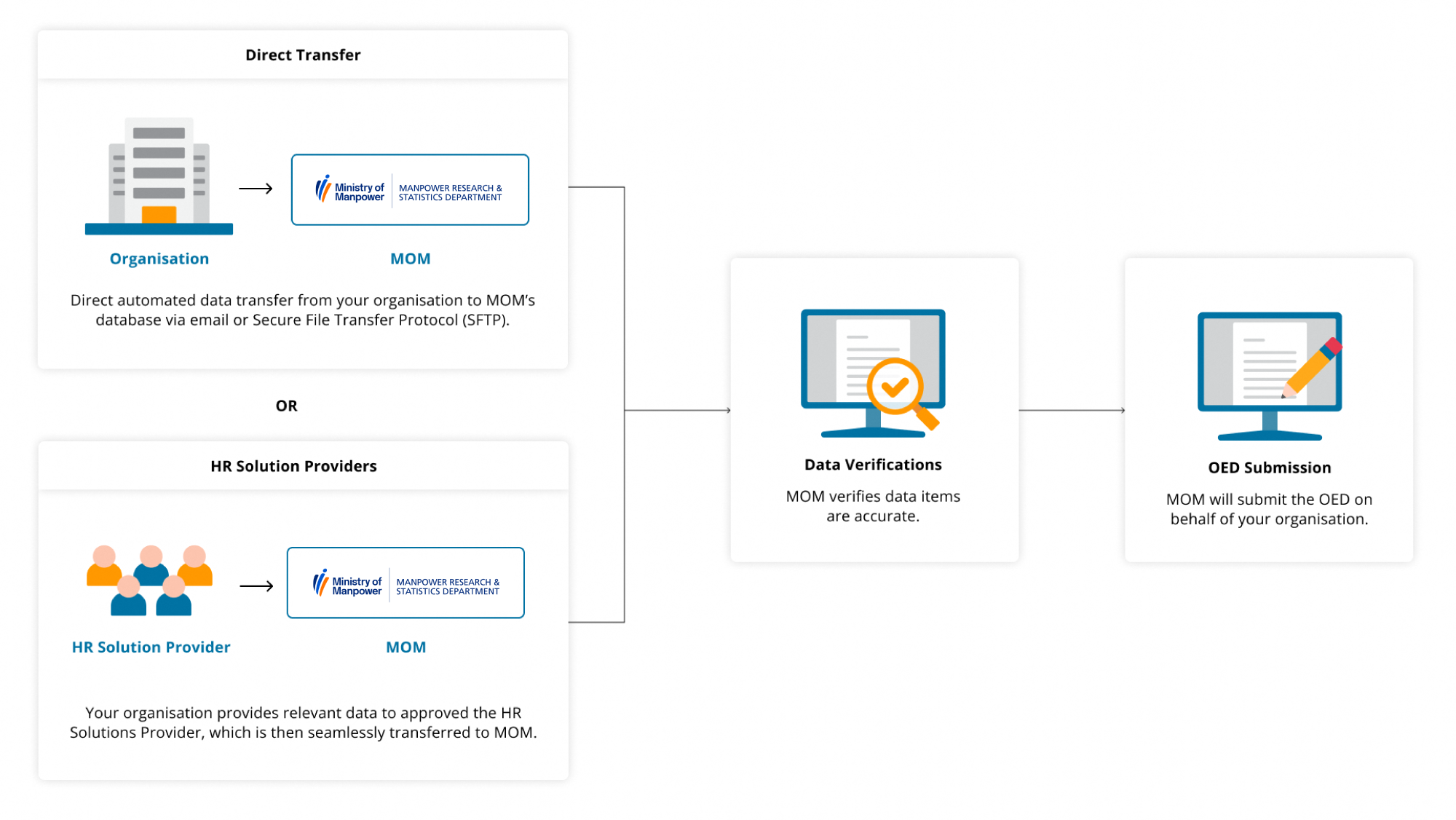
The ADT service facilitates the collection of data for OED - businesses that sign up for the ADT service can enable MOM to update their information in the OED on their behalf, streamlining the submission process for their HR representatives.
What is the Automated Data Transfer (ADT) Service?
The ADT service streamlines the data collection process for the OED. It uses an SFTP (Secure File Transfer Protocol) connection to link an organisation’s HR database to MOM’s database, so that relevant data can be directly transferred to MOM.
How does the ADT Service work?
As an organisation or a HR solutions provider, simply apply for the service and complete an initial set-up. After that, the ADT will transfer the data directly to MOM via an SFTP connection. MOM will then verify the data and may contact you if there are any anomalies. If the data checks out, MOM will proceed to submit the OED on the organisation’s behalf.
Consent, Data Use and Access
Why do I need to provide consent for my OED data?
To safeguard your organisation's information, we need your explicit consent before sharing any details with other government agencies.
Under government data sharing guidelines, we may share your information only for the purposes below.
Purposes for which information may be shared with respective agencies
Purpose | Agencies Involved |
Progressive Wage Model (PWM) Assessment | Ministry of Manpower:
|
Progressive Wage (PW) Mark Assessment | Singapore Business Federation (SBF), Tripartite Alliance for Fair & Progressive Employment Practices (TAFEP) |
Development of Career Portal | Whole-of-Government (WOG) |
Research Purposes | Ministry of Defence (MINDEF) |
Who can fill up the OED consent form?
The consent form must be completed by:
An authorised representative of your organisation
One submission is required per Unique Entity Number (UEN)
How do I submit the consent form?
Submit consent with CorpPass here (opens in new tab).
Unable to log in using your CorpPass?
Your CorpPass admin needs to complete the following steps:
Log in to CorpPass
Go to 'eService Access’
Select 'FormSG (Ministry of Manpower)’
Assign it to your account
What are the implications if I do not provide consent for my OED data to be used for the assessment for the Progressive Wage Model (PWM) and Progressive Wage (PW) Mark?
Failure to provide relevant consent may result in the delay of assessing your organisation’s eligibility for hiring foreign workers and will affect your organisation’s eligibility for the PW Mark and PW Mark Plus.
What should I provide under Main Job Title if my employees have several different job roles?
We highly recommend providing the main job title that accurately reflects the main responsibilities your employees have consistently carried out for most of their work duration. This will require your organisation’s understanding of your employee’s workload. Similarly, organisations should adopt this approach when selecting their employees’ PWM’s Job Level.
Can employees access the OED to view their own employment information?
Employees will not have access to the organisation’s OED. However, PWM employees will be able to see which PWM Job Level their organisations have selected for them on our PW portal.
I have multiple entities under my organisation, do I have to log in multiple times to submit my OED?
You would be required to log in to the OED portal using each of your organisation’s entities to submit their respective OED.
Alternatively, you can sign up to be part of our ADT program, which will allow for your organisation’s data to be transferred to our platform monthly.
MAS-MOM Joint Manpower Data Collection
What is the purpose of joint manpower data collection?
As part of our commitment to consistently improve the survey experience for businesses, MAS and MOM are conducting a joint collection of manpower data under MOM’s Occupational Employment Dataset (OED).
With this joint manpower data collection, organisations need only complete one submission under MOM’s OED, instead of providing two separate responses to MAS (in the form of the annual Manpower Survey (MS) and MOM.
Who will be involved in this joint manpower data collection?
This involves the participation of all Financial Institutions and their relevant affiliate entities.
Why is my participation in this joint manpower data collection necessary?
Your submission is important for the development of relevant manpower programmes and initiatives for the industry, and to address competency gaps. Please be assured that while data may be disclosed at the industry-aggregate level, the firm-specific data provided will be kept strictly confidential under the Statistics Act 1973.
Does this joint manpower data collection mean that I will no longer be asked to submit the MAS’ annual Manpower Survey (MS) separately?
Yes, the joint manpower data collection is a collaboration between MAS and MOM, aimed at alleviating Financial Institutions’ administrative load. By submitting your required data through the OED, the relevant data submitted on MOM-MRSD’s survey portal will be shared with MAS. There will be no need for a separate response to MAS’ MS.
Is participation in this joint manpower data collection compulsory?
Yes. The joint manpower data collection is conducted under the OED, which is overseen by the Statistics Act 1973. Under this Act, it is mandatory for organisations to provide all necessary information.
How do I submit my data for the joint manpower data collection?
As this is conducted under the OED, the submission process remains the same as how organisations would complete their regular OED submission via MOM-MRSD’s survey portal (opens in new tab).
I see new data columns in the submission template which were not present in my previous OED submissions. How do I fill up these data items?
These additional data columns you now see in your submission are adopted from MAS’ annual Manpower Survey (MS). Please refer to the respective sections below for data-specific information.
Additional data items - Seniority
To identify an individual’s Seniority Level, please refer to the details below outlining the similarities and differences across the various Seniority labels.
Comparison of MD-Level Seniorities
Seniority Level | MD & Above | MD & Above | MD & Above | MD & Above |
Work Experience | Usually more than 15 years of related work experience | |||
Function | Undertakes executive decisions but does not hold a managerial function | Undertakes executive decisions and manages teams within the company whether at the local, regional, or global level | Undertakes executive decisions as part of the management team whether at the local, regional, or global level | Undertakes executive decisions as part of the senior management team and manages teams within the company whether at the local, regional, or global level |
Reporting Line | Reports directly to the management team or to an MD & Above (Manager) | Reports directly to the management team | Reports directly to the senior management team¹ | Forms the highest level of management in the organisation (i.e. C-suite) |
Comparisons of Authority | | They are not generally regarded as senior enough to cover some of the MD & Above (Senior Leader)’s responsibilities in the latter’s absence | They are generally regarded as senior enough to cover some of MD & Above (Senior Leader)'s responsibilities in the latter's absence | |
Regional or Global Roles | The seniority level of individuals who perform regional or global roles will be determined by comparing their rank relative to the Singapore CEO and management team2. | |||
*Smaller Financial Institutions, or Financial Institutions with a flatter hierarchy, may not have this second level of management. These Financial Institutions may skip this category and instead categorise all other managers who report to the senior management team as “MD & Above (Manager)”.
“SVP/Director” refers to professionals usually with 8 to 15 years of related work experience and with management responsibilities.
“AVP/VP” refers to professionals usually with 3 to less than 8 years of related work experience.
“Analyst/Associate” refers to employees usually with less than 3 years of related work experience, including tertiary graduates who are hired directly into specific business areas/job roles.
“Non-executive” refers to employees performing administrative roles; they are typically non-tertiary graduates earning less than $4k per month.
1 Senior Management Team refers to individuals classified under “MD & Above (Senior Leader)”.
2 The seniority of a regional/global MD will be determined by comparing his/her rank (based on his/her direct reporting line) relative to the Singapore CEO and management team. For example:
A “Head of Private Bank for South Asia” would be classified as an “MD & Above (Senior Leader)” if he/she directly reports to “Head of South Asia”, and the Singapore CEO directly reports to the “Head of South Asia” as well. His/her seniority will be considered the same as the Singapore CEO’s, and hence, assessed to be a part of top management.
A “Head of Private Bank for South Asia” would also be classified as “MD & Above (Senior Leader)” if he/she directly reports to the “Head of Asia”, while the Singapore CEO directly reports to the “Head of SEA” (which is lower in the corporate hierarchy compared to the Head of Asia). He/she will then be assessed to be more senior than the Singapore CEO, and therefore part of top management.
A “Head of Private Bank for South Asia” would be classified as “MD & Above (Manager)” if he/she directly reports to the “Head of Wholesale Bank for South Asia” (C-1), who in turn directly reports to “Head of Institutional and Clients South Asia” (C) which is equivalent in seniority to the Singapore CEO (C). He/she will be likely assessed to be C-2, as the “Head of Institutional and Clients South Asia” is C-suite level (“Senior Leader”) and 2 reporting levels above him/her while the “Head of Wholesale Bank for South Asia” is C-1 (“Leader”) and 1 reporting level above him/her.
Additional data items - Business Area & Job Role
Q: How do I fill in the data field if a particular business area in my institution is not listed?
Please refer to the dropdown options in the employee listing and pick the business area that is the closest match to the type and nature of the particular business area in your organisation.
Q: How do I fill in the job role data field?
Please refer to the glossary in the submission template for more information on the various job roles and select the job role that is the closest match to the type and nature of the job role in your organisation.
The job roles were adapted from the Skills Frameworks for Human Resource, Accountancy, Information Technology and Financial Services sectors.
Q: How do I fill in the data field(s) if an employee’s job scope spans multiple job roles?
In instances where an employee’s job scope spans multiple job roles, please indicate the employee’s headcount wholly under the job role that accounts for the most man-hours or best reflects the employee’s core responsibility.
Q: How do I complete the submission for financial advisors/planners or insurance agents?
If the financial advisors/planners or insurance agents are employed by the company and their payroll is under the purview of the company, their details can be filled up as follows: Business Areas – Insurance Job Roles – Financial Planner/Insurance Agent/Bancassurance Specialist.
If the financial advisors/planners or insurance agents are not employed by the company (i.e. under an agency), the FI should not reflect the individual in the submission.
Additional data items - Geographic Coverage
Q: How do I fill in the Geographical Coverage?
The Geographical Coverage refers to the predominant (>50%) market that individual employees cover. For instance,
If an employee’s work scope fully relates to the Singapore domestic market, select “Domestic (100%)”;
If at least 50% of an employee’s work scope relates to the Singapore domestic market, and covers some regional or global work, select “Domestic (At least 50%, but less than 100%)” as the coverage; or
If an employee’s job scope predominantly covers clients or activities in the regional or global market, please select “Regional (At least 50%)” or “Global (At least 50%)” respectively.
Please refer to the table and examples below for more information.
Definitions of Geographic Coverage labels
Geographic Coverage | Remarks |
Global | The role focuses primarily on supporting activities or clientele in most or all overseas markets in which the group operates. |
Regional | The role focuses primarily on supporting activities or clientele in the region (e.g. Southeast Asia, Asia Pacific). |
Domestic | The role focuses primarily on supporting activities or clientele originating from Singapore, such as local clients and firms (i.e., excluding expatriates, and foreign entities based in Singapore, such as Multi-National Corporations). |
Examples:
Operations analyst working in an international FI with presence in Asia (including SEA) and Europe. The analyst covers operations in SEA for 60% of his work, while the remaining 40% supports domestic operations for local firms. In this case, the analyst’s geographic coverage should be “Regional (At least 50%)”.
Compliance officer employed in an FI with a presence in Southeast Asia, but only covers regulatory compliance for business activities in Singapore. This officer’s geographic coverage should be “Domestic (100%)”.
Transaction Banking Operations officer in an international FI that supports cash flow management for global Multi-National Corporations based in Singapore for 75% of his/her time, while the remaining 25% of the time is spent on supporting local firms. The officer’s geographic coverage should be “Global (At least 50%)”.
Wealth Planning officer in an international FI that supports financial planning management for regional clients based in Singapore for 75% of his/her time, while the remaining 25% of the time is spent on supporting local clients. The officer’s geographical coverage should be “Regional (At least 50%)”.
Software Engineer with an international FI that supports the development of group-wide applications used by all entities in the group for 75% of his/her time, while the remaining 25% of the time is spent on supporting the development of an application contextualised only for the domestic market in Singapore. The software engineer’s geographic coverage should be “Global (At least 50%)”.
Private Banking Relationship Manager (RM) in an international FI with global presence. The RM, while based in Singapore, covers clients in the North Asia Market (Hong Kong, China, Taiwan etc.) 100% of the time. This RM’s geographic coverage should be “Regional (At least 50%)”.
Private Banking RM in a local FI with presence in Asia. The RM serves expatriates from Southeast Asia who are based in Singapore 100% of the time. This RM’s geographic coverage should be “Regional (At least 50%)”.
Corporate Banking RM in a local bank with presence in Asia. The RM only serves local SME clients based in Singapore (100% of the time). This RM’s geographic coverage should be “Domestic (100%)”.
Private Banking RM in a local bank with presence in Asia. The RM primarily serves expatriate clients, who may be based in Singapore or in the region. This RM’s geographic coverage should be “Regional (At least 50%)”.
Portfolio Manager in a local asset management firm with an investment mandate focused on a regional market. This portfolio manager’s geographic coverage should be “Regional (At least 50%)”, notwithstanding that the clients of the local asset management firms are mostly local.
Contact us
If your establishment requires assistance with the OED or a survey, please contact us at:
Hotline: +65 6320 7722 (Monday to Friday, 8.30am to 5.30pm, excluding public holidays)
Email: mom_oed@mom.gov.sg
Online contact forms:
Establishment surveys (opens in new tab)
Occupational Employment Dataset (opens in new tab)
Beware of impersonation scams
MOM officers will never ask you to transfer money or disclose bank log-in details over a phone call or email. Find out more on how to transact safely and securely (opens in new tab). Call the 24/7 ScamShield Helpline at 1799 if you are unsure if something is a scam.