
Employment Conditions
Understand employment conditions in Singapore, including leave entitlements, flexible work arrangements and sickness absenteeism across workplaces.
Last updated on 5 November 2026
In Brief
Employment conditions statistics provide information on workplace practices and working arrangements for employees.
The statistics cover annual leave entitlements, non-statutory leave, flexible work arrangements and sickness absenteeism.
These indicators provide insights into employment practices and work-life arrangements across industries and establishments.
As part of MRSD’s commitment to deliver accurate and relevant statistics, our data collection processes have undergone an assessment by Ernst and Young Advisory Pte Ltd.
Understanding employment conditions statistics
Employment conditions statistics cover four main areas: annual leave entitlement, non-statutory leave, flexible work arrangements and sickness absenteeism.
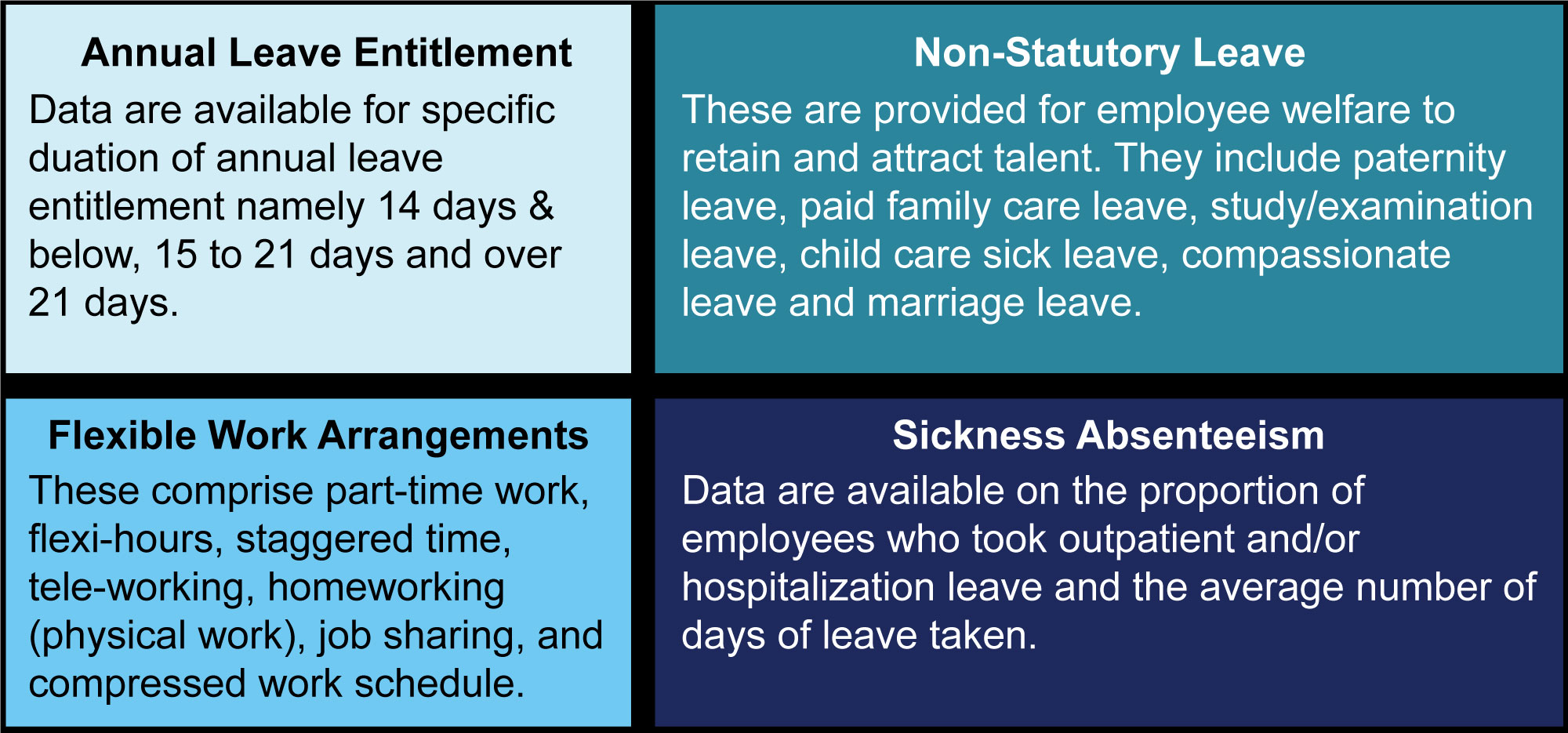
Categories of employment conditions for which data are available
Annual Leave Entitlement
The leave entitlement of full-time employees for a year of service.
Data are available for specific durations of annual leave entitlement: 14 days and below, 15 to 21 days, and over 21 days.
Non-Statutory Leave
Leave provided by employers for employee welfare and to attract and retain talent.
This includes:
Paid Family Care Leave
Paid leave granted to employees to care for family members, such as parents, stepparents, parents-in-law, children or spouses, or to accompany them for medical appointments when they are sick or when the main caregiver is unavailable.
Paid Study/Examination Leave
Paid leave given to employees to attend or pursue a full-time course, such as a diploma or degree course.
Flexible Work Arrangements
Working arrangements that provide employees with flexibility in when, where or how they work.
These include:
Part-time Working
Working less than 35 hours a week, including employees who work half-days or only some days per week. This excludes workers who work on-and-off and temporary employees working normal hours.
Staggered Time
An arrangement with different starting and finishing times around compulsory core working hours.
Job Sharing
An arrangement where the workload of a full-time job is shared between two or more people who work at different times.
Homeworking (physical work)
An arrangement where employees work mainly from home without using information and communication technologies. It excludes tele-working.
Unplanned Time-off to Attend to Personal Matters
Time off granted to attend to personal matters. Employees may or may not be required to make up the time away from work.
Flexi-hours
An arrangement where employees vary their daily working hours to suit work and personal commitments while completing the agreed total working hours over an accounting period.
Tele-working
An arrangement where employees work away from the office using information and communication technologies for an extended period.
Tele-working may take two forms:
Scheduled tele-working: Employees tele-work for an agreed period of time.
Non-scheduled tele-working: Employees tele-work on an ad-hoc basis, such as for personal reasons or family emergencies.
Compressed Work Schedule
An arrangement where a standard work-week is condensed into fewer than five days, allowing employees to complete their workload over a shorter period.
Shift Swapping
An arrangement that allows shift workers to trade shifts with one another to accommodate personal needs and family responsibilities.
Time Banking
An arrangement where the employer and employee agree on a fixed number of work hours over a specified period. Additional hours worked may be accumulated and subsequently taken as time off in lieu.
Employees’ Choice of Days Off
An arrangement that allows employees to plan their work schedules and determine their days off, while ensuring operational needs are met.
Sickness Absenteeism
The actual sick leave taken by employees, whether paid or unpaid.
It includes sick leave under the Work Injury Compensation Act, but excludes maternity and annual leave.
Data are available on the proportion of employees who took outpatient and/or hospitalisation leave and the average number of days of leave taken.
How employment conditions statistics are compiled
Source and Coverage
Data on employment conditions are collected through the biennial Conditions of Employment Survey.
The survey covers private sector establishments each with at least 25 employees and the public sector, comprising government ministries, organs of state and statutory boards.