
Labour Force
Understand labour force participation in Singapore — from the size of the labour force to how actively residents participate in the labour market.
Last updated on 3 November 2026
In Brief
The labour force comprises persons aged 15 years and over who are employed or actively seeking employment.
Labour force participation rates show how actively people engage in the labour market.
Participation trends help provide insights into the economy's available manpower resources and future labour force supply.
Latest data
67.9%↓
Resident Labour Force Participation Rate | (2025)
As part of MRSD’s commitment to deliver accurate and relevant statistics, our data collection processes have undergone an assessment by Ernst and Young Advisory Pte Ltd.
Summary table
Labour Force
Mid-Year | 2025 | 2024 | 2023 | 2022 | 2021 | 2020 | 2019 | 2018 | 2017 | 2016 | 2015 |
|---|---|---|---|---|---|---|---|---|---|---|---|
Resident Labour Force ('000) | 2,456.4 | 2,446.4 | 2,436.2 | 2,438.0 | 2,397.8 | 2,345.5 | 2,328.5 | 2,292.7 | 2,269.7 | 2,257.6 | 2,232.3 |
Educational Composition (%) | 100.0 | 100.0 | 100.0 | 100.0 | 100.0 | 100.0 | 100.0 | 100.0 | 100.0 | 100.0 | 100.0 |
Below Secondary | 11.8 | 11.4 | 12.2 | 12.7 | 13.0 | 14.3 | 15.1 | 15.9 | 17.6 | 18.2 | 18.2 |
Secondary | 12.6 | 13.2 | 13.6 | 14.0 | 14.3 | 15.4 | 16.0 | 16.4 | 16.5 | 17.1 | 18.2 |
Post-Secondary (Non-Tertiary) | 11.5 | 11.5 | 11.4 | 11.4 | 11.2 | 11.5 | 11.2 | 11.5 | 11.3 | 11.5 | 12.0 |
Diploma & Professional Qualification | 20.4 | 20.5 | 20.4 | 20.3 | 20.2 | 19.8 | 20.1 | 19.5 | 18.9 | 19.4 | 19.3 |
Degree | 43.7 | 43.3 | 42.4 | 41.6 | 41.3 | 39.1 | 37.5 | 36.7 | 35.7 | 33.7 | 32.2 |
Median Age (Years) | 45.0 | 45.0 | 44.0 | 44.0 | 43.0 | 44.0 | 44.0 | 43.0 | 43.0 | 43.0 | 43.0 |
Labour Force Participation Rate (%) | 67.9 | 68.2 | 68.6 | 70.0 | 70.5 | 68.1 | 68. 0 | 67.7 | 67.7 | 68.0 | 68.3 |
Source: Comprehensive Labour Force Survey, Manpower Research & Statistics Department, MOM
Latest figures published in: Labour Force in Singapore
Notes
Data are for mid-year.
Labour force participation rate measures the proportion of the population aged 15 years and over that is participating in the labour market.
Residents refer to Singapore Citizens and Permanent Residents.
Understanding labour force statistics
Labour force statistics are commonly interpreted through three related measures: working-age population, labour force and labour force participation rate.
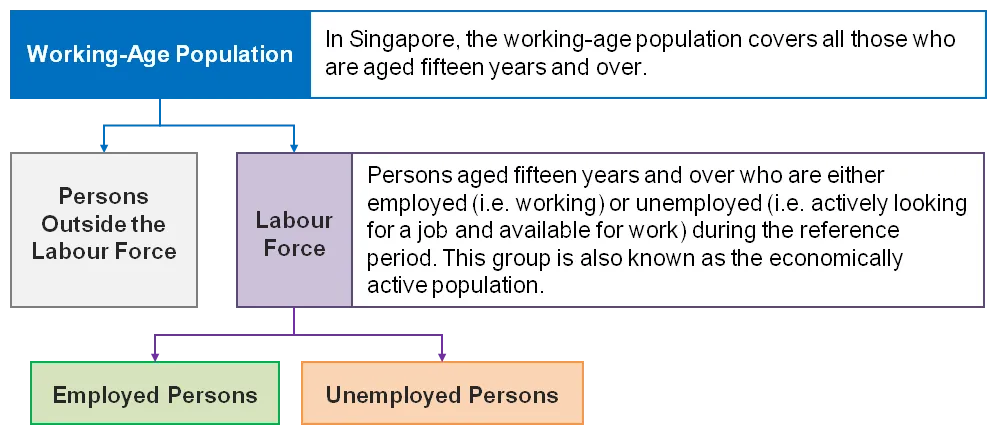
Breakdown of groups within working-age population
Working-Age Population
In Singapore, the working-age population covers all those who are aged fifteen and over.
Labour Force
Persons aged fifteen years and over who are either employed (i.e. working) or unemployed (i.e. actively looking for a job and available for work) during the reference period.
Labour Force Participation Rate (LFPR)
The Labour force participation rate (LFPR) is defined as the percentage of the labour force to the working-age population.
How labour force data is compiled
Singapore's labour force statistics are compiled from the Comprehensive Labour Force Survey.
The survey collects information on employment and unemployment, as well as characteristics of persons in and outside the labour force. This provides a national picture of labour force participation and labour supply.
Labour force data source
Source and Coverage
Data on the labour force are compiled from the mid-year Comprehensive Labour Force Survey.
The survey covers private households in Singapore. It excludes workers living in construction worksites, dormitories and workers' quarters at the workplace, as well as persons commuting from abroad to work in Singapore.
Estimates of the total labour force are derived by combining resident survey data with non-resident employment data compiled from administrative records.
Uses and Limitations
Labour force participation rate (LFPR) provides insights into labour force participation and the manpower resources available in the economy.
Detailed breakdowns by age and sex help identify differences in labour market participation across population groups and support manpower planning.
LFPR does not include discouraged workers who have stopped actively looking for work. These individuals are classified as persons outside the labour force, also known as the economically inactive.