
Mean
Understanding the concept of the mean, its uses and limitations
Last updated on 1 November 2026
Understanding mean
The mean refers to the average value among a set of observations. It is obtained by adding the values across all observations together followed by dividing the total by the number of observations.
Example: Deriving the mean
This example illustrates how the mean is calculated.
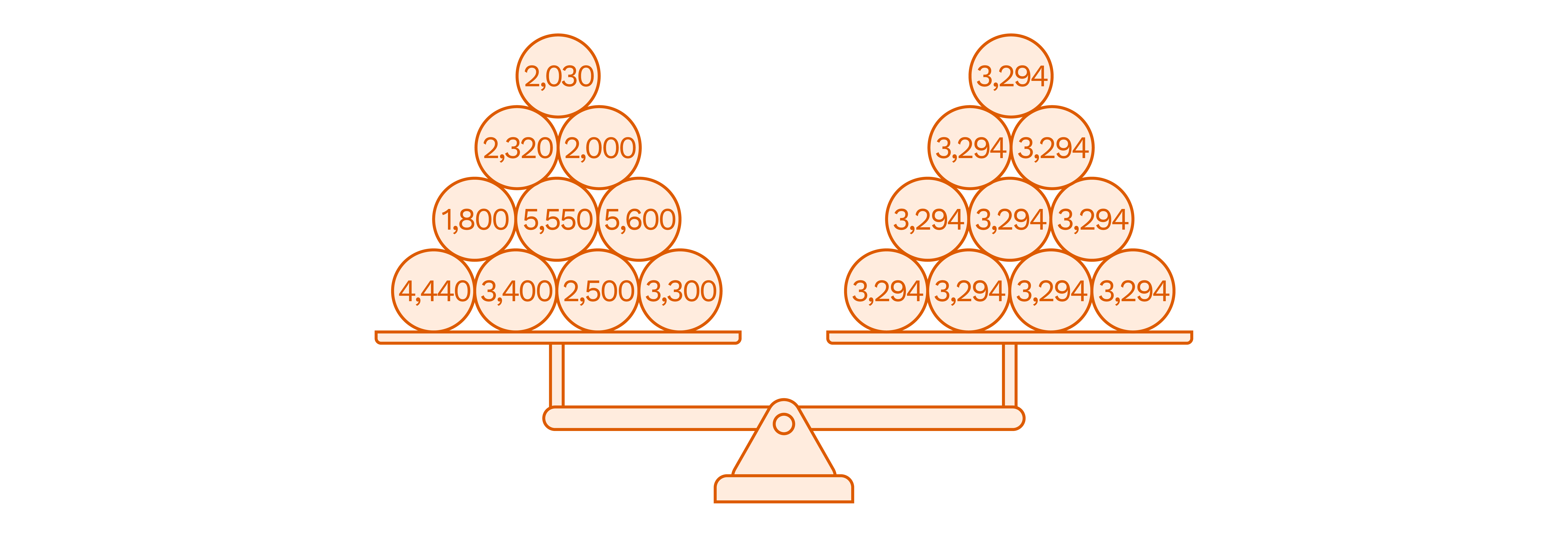
Suppose a company has ten employees. The table below shows their monthly basic wages.

To obtain the average monthly basic wage, we need to add all the monthly basic wages of these employees and divide the this by the total number of employees in this company.

This means that if the total basic monthly wages were to be shared equally among all ten employees, each employee would receive $3,294.
Uses of the mean
The mean can be used to represent the typical value and therefore serves as a yardstick for comparisons.
As a typical value, the mean can also be used to make further calculations about a group.
Example: Making comparisons
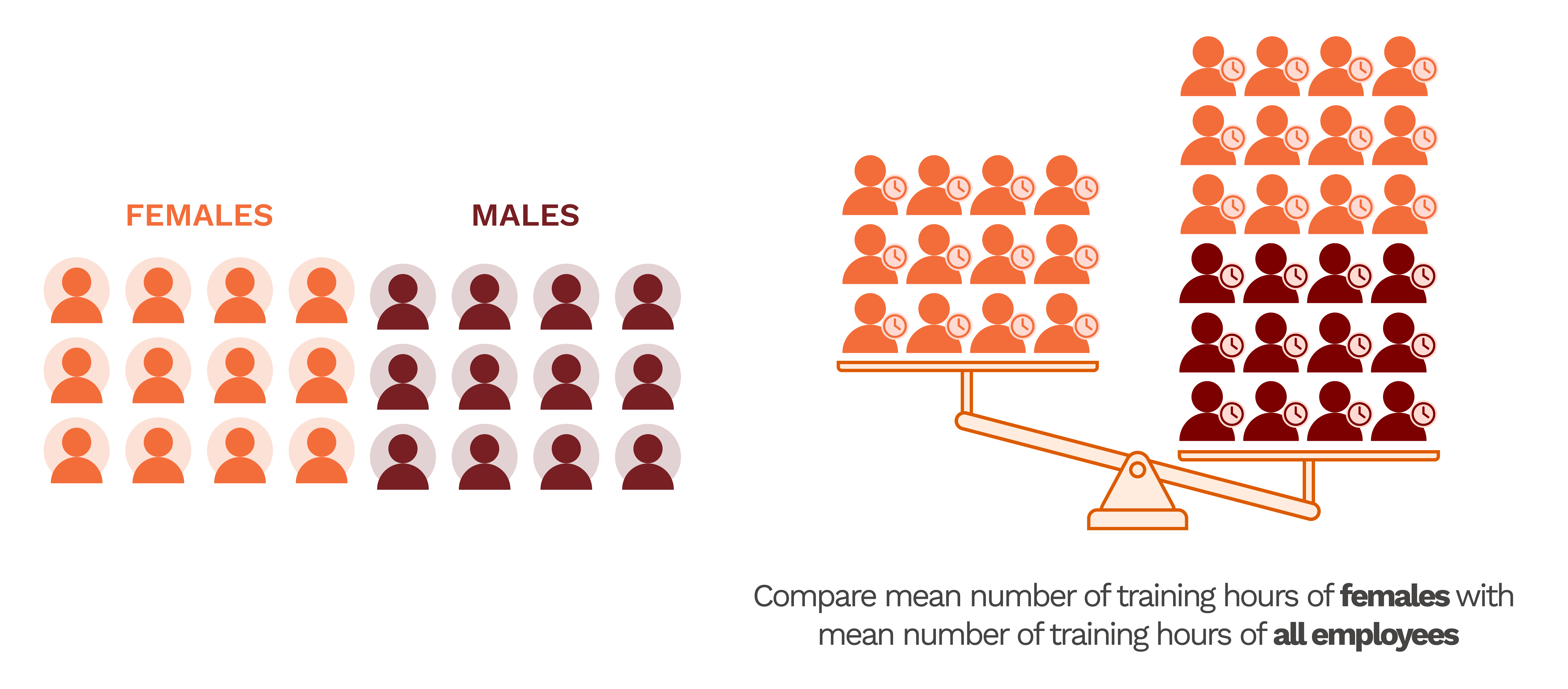
The average training hours for a group of employees can be calculated to find out how many hours an employee spends on training in a year.
This average can then be compared with an individual's annual training hours to see whether they have received a similar amount of training as their colleagues.
Average training hours can also be compared across different groups. For example, the average annual training hours for women can be compared with the average for all employees.
Example: Further calculations
To find out how much it would cost a company to give each worker a 5% wage increase, it is not necessary to calculate a 5% wage increment for each individual worker.
Instead, with the mean wage and the number of workers in a company, this can be derived by:
1. Calculating a 5% increase from the mean wage
2. Multiplying this number by the number of workers.
Limitations
The mean is sensitive to extreme values in data. It should be interpreted with caution when the distribution is skewed, i.e. when there are a small number of extreme values in the group. In such cases, the mean might no longer be a good summary of a group’s “typical” wage. A better alternative would be the median.
The mean cannot be computed based on qualitative data. Suppose individuals who have changed jobs are surveyed about whether their income in the new job is "higher", "the same as", or "lower" than in their previous job, without being asked to state the actual difference in income.
In this case, the mean income change cannot be calculated because the size of the income changes is unknown.
However, the most common response (the mode) can still be determined, as the number of each response can be quantified, as well as the middle response (the median), as the responses can be ordered: "higher" ranks above "the same as", which in turn ranks above "lower".