
Ratios
Understanding the concept of ratios, their uses and limitations
Last updated on 1 November 2026
Understanding ratios
Ratios offer a concise way to compare the size of one variable with another. For example, the ratio of job vacancies to unemployed persons compares the number of job openings with job seekers.
Uses of ratios
Ways to express a ratio
Suppose we are taking a ratio of Variable A to Variable B where
Variable A = 5 and
Variable B = 4.
We can express this ratio in one of the two forms shown in the flowchart below. Note that A refers to the value of Variable A and likewise for B.
Different forms of ratios and how to interpret them
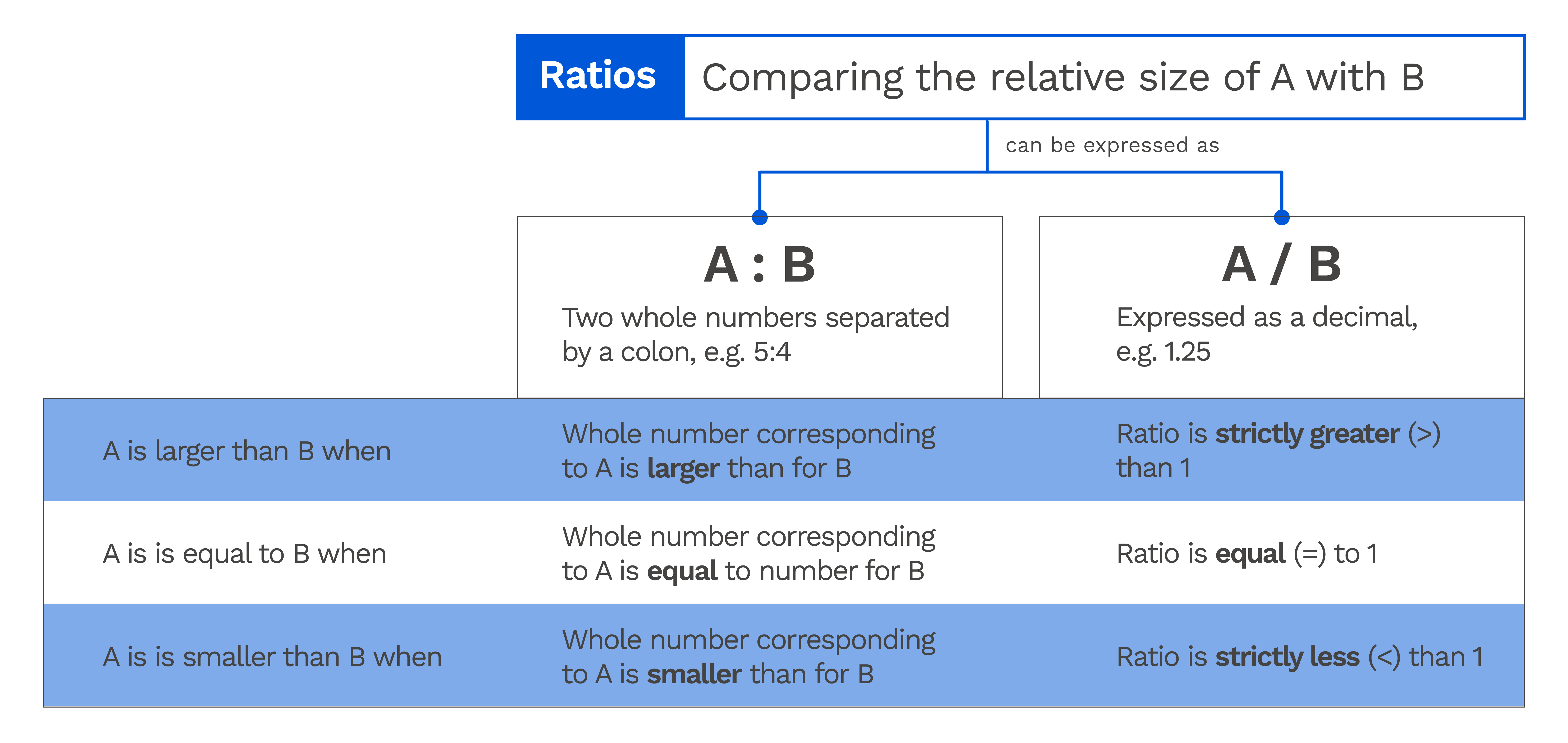
Although the interpretation for the first ratio expression is more straightforward, expressing a ratio as a decimal normalises the denominator (or variable B) to 1. Such normalisation facilitates the comparison of two or more ratios, such as comparison across time or across groups. For example, it is easier to interpret the difference between the ratios 1.25 and 1.50, instead of 5:4 and 3:2.
Another point to note is that ratios do not normally have units, especially when the two variables share the same units.
Example 1: Using ratios
Suppose we are comparing the wages for two occupations, A and B.
Suppose the median monthly wage for occupation A is $2,000 and that for occupation B is $3,000. In this case, the ratio in decimal form is $2,000/$3,000 = 0.67. As the ratio is less than 1, this means the median wage for occupation A is less than the median wage for occupation B. The ratio has no units since the median wage for both occupations A and B are in dollars.
Occupation A Has Lower Median Wage Than Occupation B

Suppose instead that the median wage for occupations A and B are both $3,000. The ratio of the wages in decimal form is 1.00, implying that the quantities compared have the same value.
Occupation A Has the Same Median Wage as Occupation B

Finally, suppose the median wage for occupation A is $3,000 and that for occupation B is $2,000. The ratio of the wages in decimal form is 1.50, which exceeds 1. This means that the first quantity (here, median wage of occupation A) is larger than the second quantity (median wage of occupation B).
Occupation A Has Higher Median Wage Than Occupation B

Limitations
While ratios provide information on the relative size of two variables, it does not provide information on their actual sizes.
Similarly, the change in the relative size of two variables by itself does not tell us how the actual sizes of the two variables have changed.
Example 2
An increase in ratio might not mean an increase in both variables.
Suppose the ratio of the median wage for occupation A to the median wage for occupation B increased from 1.50 in year 1 to 1.60 in year 2.
There are several possible changes in the median wages of the two occupations that could have resulted in this change. Information about changes in median wages cannot be interpreted from the changes in ratios alone.
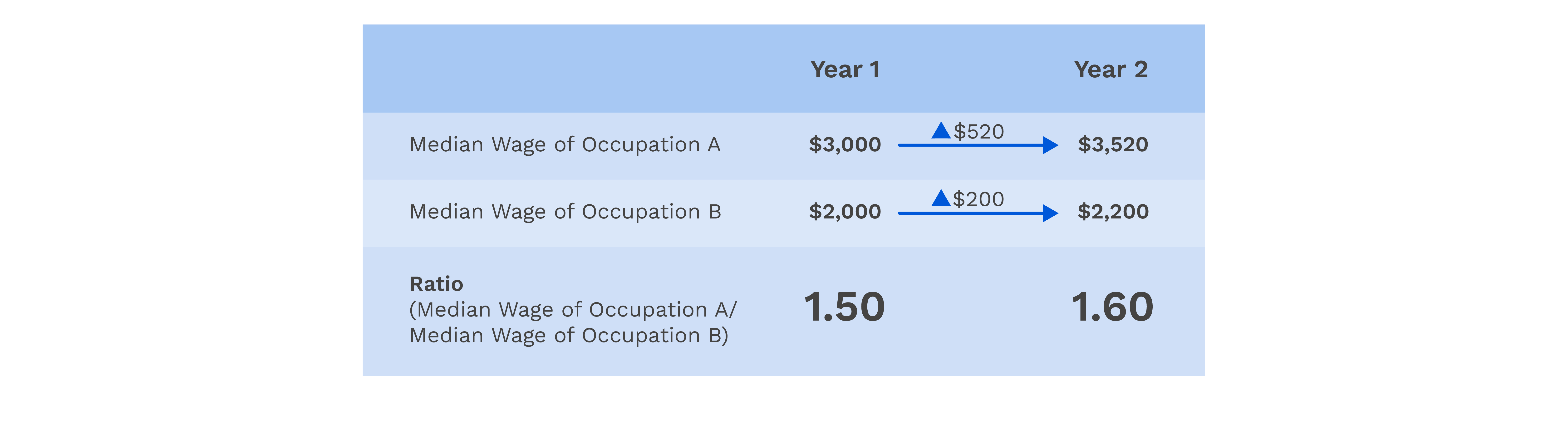
The increase in ratio can take place when the median wages for both occupations A and B increased, with A increasing by a larger percentage than B.
Increase in Wage Ratio When Median Wage of A Rose Faster Than Median Wage of B
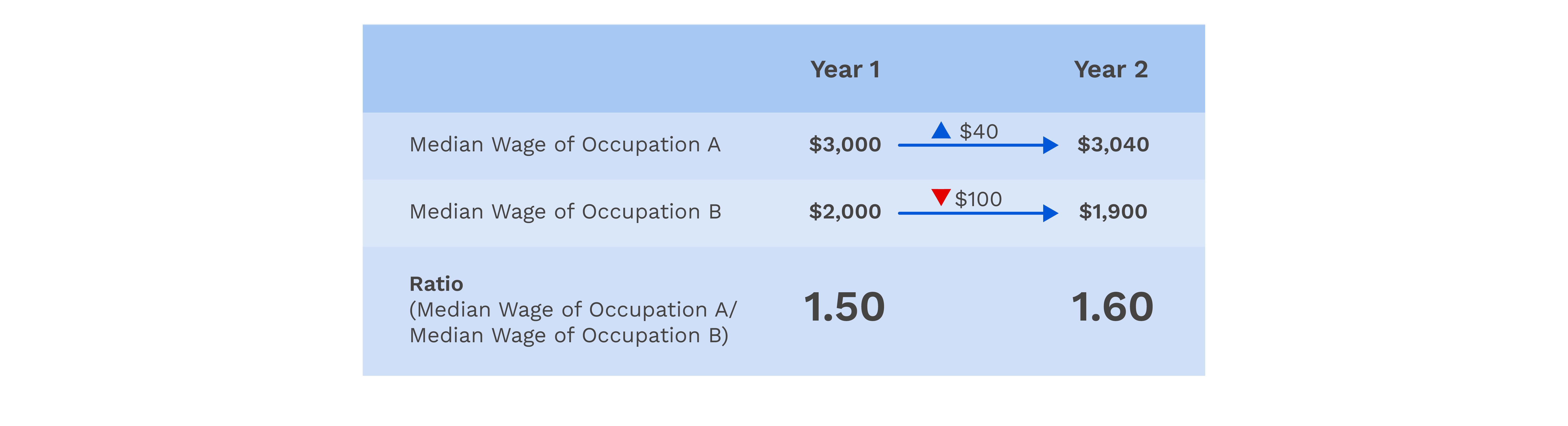
Another scenario is when the median wage of occupation A increased, while the median wage of occupation B decreased.
Increase in Wage Ratio When Median Wage of A Increased and
Median Wage of B Decreased
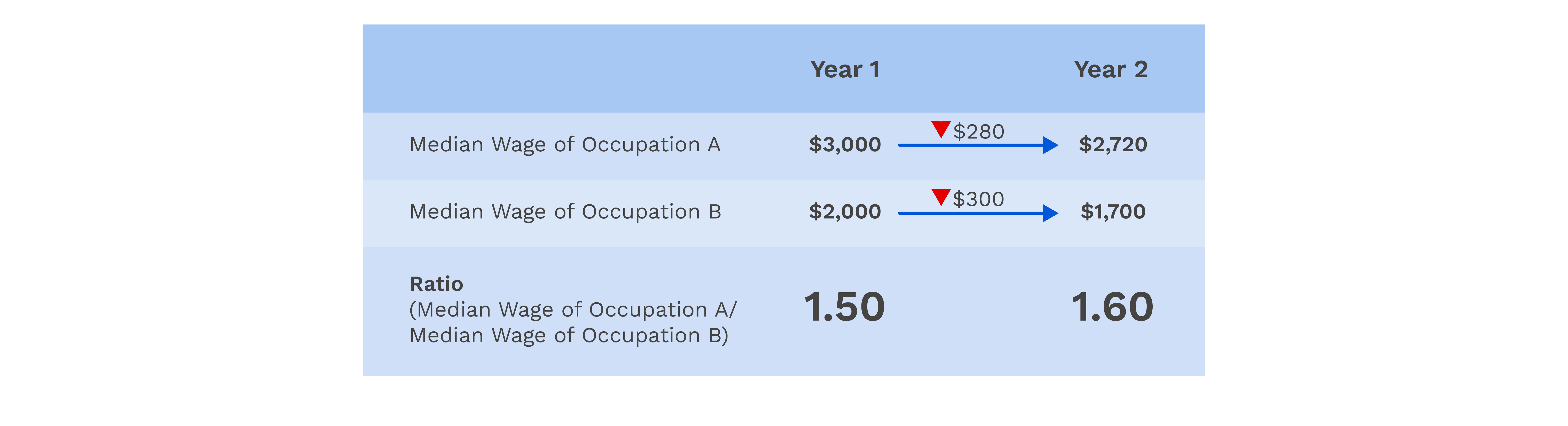
The wage ratio can also increase when the median wage of both occupations A and B decrease, with occupation B decreasing by a larger percentage.
Increase in Wage Ratio When Median Wage of A Decreased Slower Than Median Wage of B
Therefore, a change in the ratio across time from 1.50 to 1.60 can result from increases or decreases in the median wages of occupations A and B.