
Sample and Population
Understanding the concepts of sample and population, their uses and limitations
Last updated on 1 November 2026
Understanding sample and population
A population is a group of individuals or units (e.g. households, companies) that one would like to understand. Specifically, we call this group the target population. Let’s look at an example.
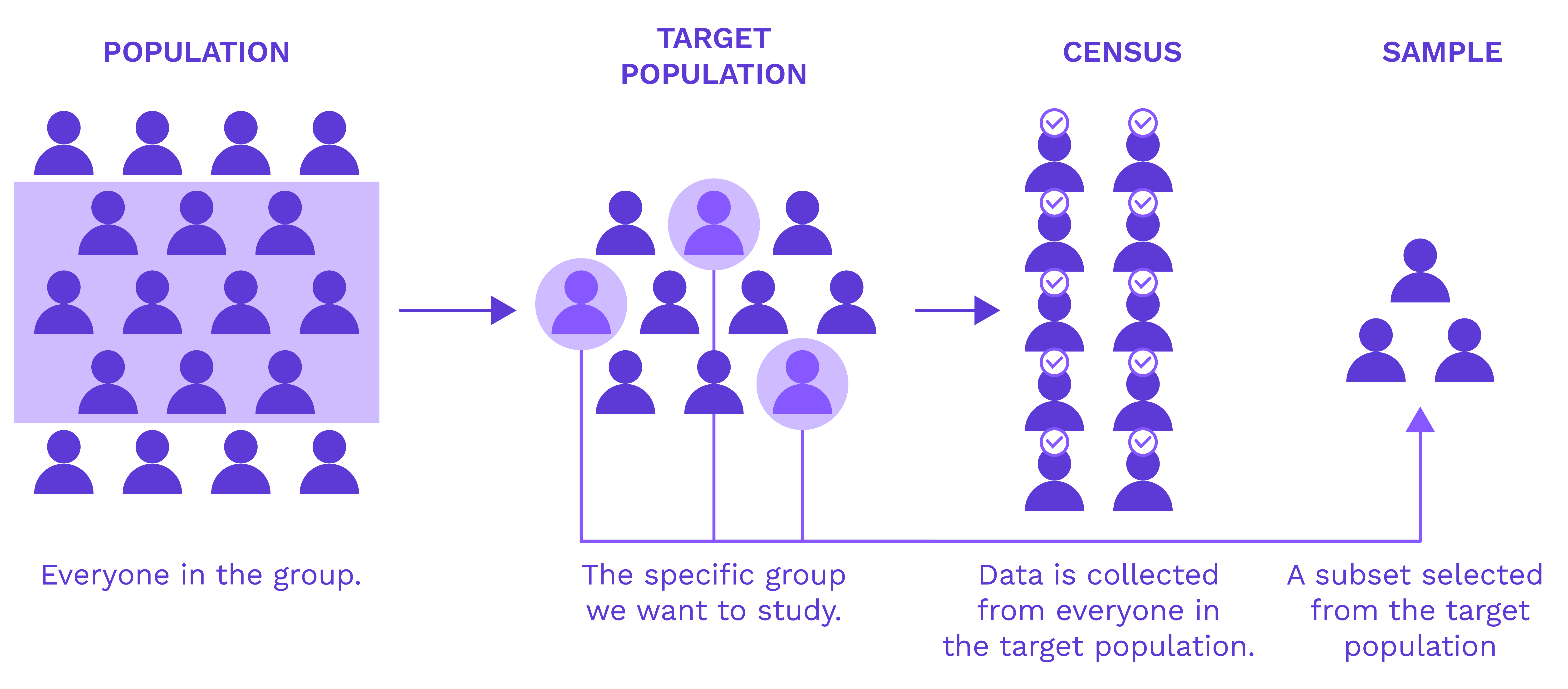
The example introduced two types of surveys; a census and a sample survey.
Census: A census is a survey that collects data from all persons or units in the target population.
Sample: A sample is a subset of the target population from which data are collected. For each population, there are many possible samples. Careful steps are taken in selecting this sample to ensure that it is representative of the target population, so that the findings from the sample survey can be extended to the target population.
The sample survey is a common method used to collect information on the population of interest, usually due to resource constraints.
Uses
When to use a sample or census survey
To obtain information on the population, one can choose to carry out a census or a sample survey. To capture a comprehensive picture of the population, it is best to have as large a sample as possible. However, this is not always achievable. Data collectors have to consider:
Availability of resources like budget, time and manpower,
Respondent burden, and
Accuracy required, bearing in mind the level of detail of the information needed.
Limitations
There are many ways to select samples from the population. It is important to use a method that allows us to select a sample that is representative of the target population for reliable results to be obtained.
Obtaining a representative sample
Sometimes, we hear people mentioning that the sample selected for a survey is representative, as the demographic composition (e.g. age) in the sample closely matches that of the target population. However, this does not necessarily result in a representative sample.
For example, suppose we would like to find out the monthly expenditure of people staying in a community. Selecting persons off a street to fulfill a specified number of young and old, male and female respondents based on the target population composition might not give us a representative sample. Certain groups of people may be left out; e.g. high-income earners who normally do not pass by that street. This could bias the survey results.
Representative samples are subject to sampling and non-sampling errors
Estimates (e.g. mean age) from any two representative samples of the same size, selected from the same population using the same sampling method, could differ due to sampling and non-sampling errors. Sampling errors arise when we make conclusions about a population based on the findings of a sample of this population.
On the other hand, non-sampling errors could arise when, e.g. some respondents provided inaccurate information because they interpreted the question wrongly. Learn more about sample reliability here.